
John W. Whitehead – The Rutherford Institute April 14, 2020
“The fact is that the government, like a highwayman, says to a man: Your money, or your life. And many, if not most, taxes are paid under the compulsion of that threat. The government does not, indeed, waylay a man in a lonely place, spring upon him from the road side, and, holding a pistol to his head, proceed to rifle his pockets. But the robbery is none the less a robbery on that account; and it is far more dastardly and shameful.”—Lysander Spooner, American abolitionist and legal theorist
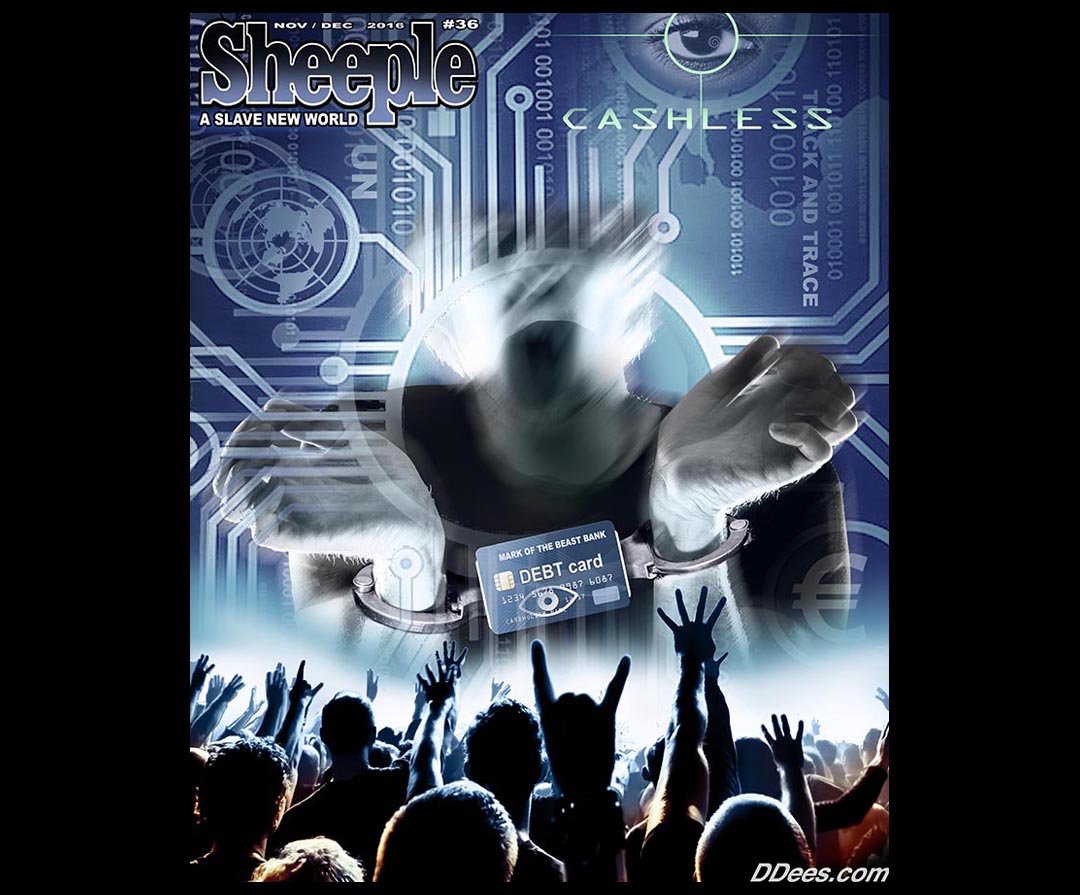
Cash may well become a casualty of the COVID-19 pandemic.
As these COVID-19 lockdowns drag out, more and more individuals and businesses are going cashless (for convenience and in a so-called effort to avoid spreading coronavirus germs), engaging in online commerce or using digital forms of currency (bank cards, digital wallets, etc.). As a result, physical cash is no longer king.
Yet there are other, more devious, reasons for this re-engineering of society away from physical cash: a cashless society—easily monitored, controlled, manipulated, weaponized and locked down—would play right into the hands of the government (and its corporate partners).
To this end, the government and its corporate partners-in-crime have been waging a subtle war on cash for some time now.
What is this war on cash?
It’s a concerted campaign to shift consumers towards a digital mode of commerce that can easily be monitored, tracked, tabulated, mined for data, hacked, hijacked and confiscated when convenient.
According to economist Steve Forbes, “The real reason for this war on cash—start with the big bills and then work your way down—is an ugly power grab by Big Government. People will have less privacy: Electronic commerce makes it easier for Big Brother to see what we’re doing, thereby making it simpler to bar activities it doesn’t like, such as purchasing salt, sugar, big bottles of soda and Big Macs.”
Much like the war on drugs and the war on terror, this so-called “war on cash” is being sold to the public as a means of fighting terrorists, drug dealers, tax evaders and now COVID-19 germs.
Digital currency provides the government and its corporate partners with the ultimate method to track, control you and punish you.
In recent years, just the mere possession of significant amounts of cash could implicate you in suspicious activity and label you a criminal. The rationale (by police) is that cash is the currency for illegal transactions given that it’s harder to track, can be used to pay illegal immigrants, and denies the government its share of the “take,” so doing away with paper money will help law enforcement fight crime and help the government realize more revenue.
Despite what we know about the government and its history of corruption, bumbling, fumbling and data breaches, not to mention how easily technology can be used against us, the campaign to do away with cash is really not a hard sell.
It’s not a hard sell, that is, if you know the right buttons to push, and the government has become a grand master in the art of getting the citizenry to do exactly what it wants. Remember, this is the same government that plans to use behavioral science tactics to “nudge” citizens to comply with the government’s public policy and program initiatives.
It’s also not a hard sell if you belong to the Digital Generation, that segment of the population for whom technology is second nature and “the first generation born into a world that has never not known digital life.”
And it’s certainly not a hard sell if you belong to the growing class of Americans who use their cell phones to pay bills, purchase goods, and transfer funds.
In much the same way that Americans have opted into government surveillance through the convenience of GPS devices and cell phones, digital cash—the means of paying with one’s debit card, credit card or cell phone—is becoming the de facto commerce of the American police state.
Not too long ago, it was estimated that smart phones would replace cash and credit cards altogether by 2020. Right on schedule, a growing number of businesses are adopting no-cash policies, including certain airlines, hotels, rental car companies, restaurants and retail stores. In Sweden, even the homeless and churches accept digital cash.
Making the case for “never, ever carrying cash” in lieu of a digital wallet, journalist Lisa Rabasca Roepe argues that cash is inconvenient, ATM access is costly, and it’s now possible to reimburse people using digital apps such as Venmo. Thus, there’s no longer a need for cash. “More and more retailers and grocery stores are embracing Apple Pay, Google Wallet, Samsung Pay, and Android Pay,” notes Roepe. “PayPal’s app is now accepted at many chain stores including Barnes & Noble, Foot Locker, Home Depot, and Office Depot. Walmart and CVS have both developed their own payment apps while their competitors Target and RiteAid are working on their own apps.”
It’s not just cash that is going digital, either.
A growing number of states are looking to adopt digital driver’s licenses that would reside on your mobile phone. These licenses would include all of the information contained on your printed license, along with a few “extras” such as real-time data downloaded directly from your state’s Department of Motor Vehicles.
Of course, reading between the lines, having a digital driver’s license will open you up to much the same jeopardy as digital cash: it will make it possible for the government to better track your movements, monitor your activities and communications and ultimately shut you down.
So what’s the deal here?
Despite all of the advantages that go along with living in a digital age—namely, convenience—it’s hard to imagine how a cashless world navigated by way of a digital wallet doesn’t signal the beginning of the end for what little privacy we have left and leave us vulnerable to the likes of government thieves and data hackers.
First, when I say privacy, I’m not just referring to the things that you don’t want people to know about, those little things you do behind closed doors that are neither illegal nor harmful but embarrassing or intimate. I am also referring to the things that are deeply personal and which no one need know about, certainly not the government and its constabulary of busybodies, nannies, Peeping Toms, jail wardens and petty bureaucrats.
Second, we’re already witnessing how easy it will be for government agents to manipulate digital wallets for their own gain. For example, civil asset forfeiture schemes are becoming even more profitable for police agencies thanks to ERAD (Electronic Recovery and Access to Data) devices supplied by the Department of Homeland Security that allow police to not only determine the balance of any magnetic-stripe card (i.e., debit, credit and gift cards) but also freeze and seize any funds on pre-paid money cards. In fact, the Eighth Circuit Court of Appeals ruled that it does not violate the Fourth Amendment for police to scan or swipe your credit card.
Third, as commentator Paul Craig Roberts observed, while Americans have been distracted by the government’s costly war on terror, “the financial system, working hand-in-hand with policymakers, has done more damage to Americans than terrorists could possibly inflict.” Ultimately, as Roberts—who served as Assistant Secretary of the Treasury for Economic Policy under Ronald Reagan—makes clear, the war on cash is about giving the government the ultimate control of the economy and complete access to the citizenry’s pocketbook.
Fourth, if there’s a will, there’s a way. So far, every technological convenience that has made our lives easier has also become our Achilles’ heel, opening us up to greater vulnerabilities from hackers and government agents alike. In recent years, the U.S. government has been repeatedly hacked. In 2015, the Office of Personnel Management had more than 20 million personnel files stolen, everything from Social Security numbers to birth dates and fingerprint records. In 2014, it was the White House, the State Department, the Post Office and other government agencies, along with a host of financial institutions, retailers and entertainment giants that had their files breached. And these are the people in charge of protecting our sensitive information?
Fifth, if there’s one entity that will not stop using cash for its own nefarious purposes, it’s the U.S. government. Cash is the currency used by the government to pay off its foreign “associates.” For instance, the Obama administration flew more than $400 million in cash to Iran, reportedly as part of a financial settlement with the country. Critics claim the money was ransom paid for the return of American hostages. And then there was the $12 billion in shrink-wrapped $100 bills that the U.S. flew to Iraq only to claim it had no record of what happened to the money. It just disappeared, we were told. So when government economists tell you that two-thirds of all $100 bills in circulation are overseas—more than half a trillion dollars’ worth—it’s a pretty good bet that the government played a significant part in their export.
Sixth, this drive to do away with cash is part of a larger global trend driven by international financial institutions and the United Nations that is transforming nations of all sizes, from the smallest nation to the biggest, most advanced economies.
Finally, short of returning to a pre-technological, Luddite age, there’s really no way to pull this horse back now that it’s left the gate. While doing so is near impossible, it would also mean doing without the many conveniences and advantages that are the better angels, if you will, of technology’s totalitarian tendencies: the internet, medical advances, etc.
To our detriment, we have virtually no control over who accesses our private information, how it is stored, or how it is used. Whether we ever had much control remains up for debate. However, in terms of our bargaining power over digital privacy rights, we have been reduced to a pitiful, unenviable position in which we can only hope and trust that those in power will treat our information with respect.
Clearly, as I make clear in my book Battlefield America: The War on the American People, we have come full circle, back to a pre-revolutionary era of taxation without any real representation.
WC: 1719
ABOUT JOHN W. WHITEHEAD
Constitutional attorney and author John W. Whitehead is founder and president of The Rutherford Institute. His new book Battlefield America: The War on the American People is available at www.amazon.com. Whitehead can be contacted at johnw@rutherford.org.
Next a tag on your ear, like cattle …
They do refer to us,as cattle ?
Who needs cash in the company store all you need is a tab and the boss a ledger.
Anyone sufficiently honest and awake by now ought to know that our nations have already made a deal for a currency reset with the China and Russia, and they ought to know that every government and leading politician is directly responsible with the media for gross exaggerations regarding this particular flu bug. They are all doing the bidding of the international central banking cartel. It is all contrived to blame the financial and economic resets in the works on the virus. The final straw for sane people ought to have been, the March 15, 2020 deliberate lies of the US Fed blaming the virus for the “necessity” of QE handouts of some 6 trillion, and the crash of the markets (i.e.,pump, short, dump by the elitist insiders). QE gargantuan handouts were not a result of the virus. The economy was already well over the edge of the cliff and falling into the black hole of depression. [Corbett Report & John Titus, https://www.thetruthseeker.co.uk/?p=205639%5D
Middle class and small businesses are presently being destroyed by the big-bank and corporate interests which are being bailed out, everyone of which special and powerful interests is fully backing the lock downs. In the reset, to balance the books, just whose assets do you think they are going to exploit? Theirs? Or yours?
Robobank, for instance, is just one of the banking agents of the international banking cartel which has overseen and is directing the psyop. Zero Hedge today published a piece by Robobank’s Michael Every providing a “reasonable” argument regarding re-openings of the economy juxtaposing such against the concern for the “second wave” of the virus, which is now being orchestrated to prolong the lockdowns. The prankster banksters need more time to do their reset, and they need to blame it on their little psyop pandemic and the resulting economic locks downs, and they will be using politicians, governments and the media now to hype the “second wave” nonsense, in order to show the “necessity” of a “vaccination” program, and stalling the re-openings as long as possible to defect the shock of the resets, leaving all the middle class and common people with savings and pension plans holding the bankster and corporate douchebag of debt. Just imagine if they were to try their long-planned world reset of finances (and your finances plundered) if people were not restricted from congregating and already restrained by the police and all the enforcement power of the state “for their own protection”.
If they have no credence because of gross CDC deliberate mis-disegations and exaggerations of causes of deaths due to the virus, and by their completely, bankster-owned politicians and their lying MSM, then how can anyone be taken in again for the “second-wave” psyop hype, obviously intended to keep the scare going as long as possible.
“Rabobank is a Dutch multinational banking and financial services company headquartered in Utrecht, Netherlands. It is a global leader in food and agriculture financing and sustainability-oriented banking.” [Wikipedia]
“Time for the big reset of monetary and fiscal policy” February 10, 2016,
https://economics.rabobank.com/publications/2016/february/time-for-the-big-reset-of-monetary-and-fiscal-policy/
Rothschild´s central bank of his central banks, The Bank for International Settlements (BIS) ålready hat the one-world digital currency, the Libra, ready to save us out of the probably upcoming hyperinflation
https://voxeu.org/article/digital-money-and-central-bank-digital-currency-executive-summary