
Christopher Booker explains how a campaign against intolerance turned into the most intolerant ideology of all
Christopher Booker – Daily Mail March 1, 2020
Chosen as Word of the Year in 2019, ‘woke’ was originally used about people sensitive to social injustice and racism.
However, it has become associated with an obsession with the pursuit of grievances – real or imagined – and has created a suffocating culture of authoritarianism.
Here, Christopher Booker- in a book written shortly before his death last year- examines the havoc it is causing.
Wherever we look, tensions and divisions exist in society that would have been hard to imagine even ten years ago.
And the issues that tear us apart are numerous: the growing influence of ‘identity politics’, whereby people form narrow and rigid alliances defined by their race, sexuality or cultural background; the omnipresent influence of social media; the fanatical intolerance of animal rights activists; the rise of Islamic terrorism; the chaotic state of British politics following the EU referendum.
Random and unrelated issues? Not at all.
It is my belief they are all connected by a phenomenon that has in recent years become increasingly influential in British life: ‘Groupthink.’
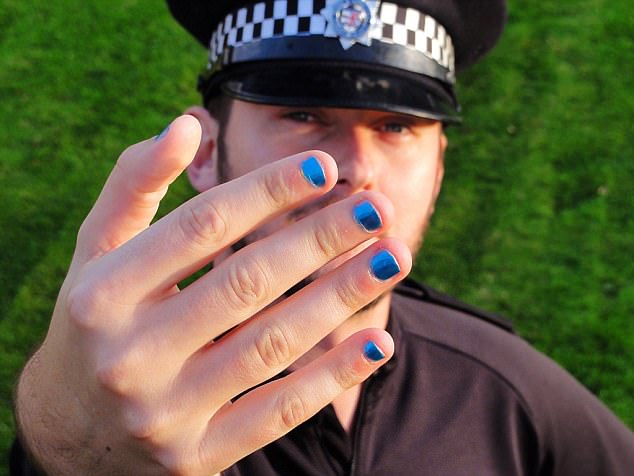
Meanwhile, in Bristol, police officers painted their fingernails blue to highlight the problem of ‘slavery in nail bars’. When this attracted witty comments on Twitter such as, ‘What about nailing some criminals?’, the bosses at Avon and Somerset Police reacted by issuing a statement saying: ‘If anyone found these comments offensive, please report them to Twitter. If you feel that you were targeted and are the victim of a hate crime, please report this to us. We take this issue extremely seriously.’ Click to enlarge
Coined in the 1970s by Irving Janis, a professor of psychology, it refers to a group of individuals fixated on a particular view of the world, whether or not there is any evidence to support it.
So convinced are they that their opinion is correct that they cannot believe any sensible person would disagree.
Most insidiously, this leads them to treat all those who differ from their beliefs with contemptuous hostility. Groupthink now comprehensively governs our lives in Britain.
From the way we are ruled and policed to the way our children are educated – even to the received wisdom about global warming – Groupthink in its many guises is at the heart of it all.
We meet its followers socially, we hear and read them incessantly in some sections of the media, and we endure our politicians speaking in the cliches of Groupthink all the time.
The psychological condition from which they are suffering is contagious, extremely powerful and increasingly showing itself to be potentially very dangerous.
Groupthink is most prevalent when we come up against people who hold an emphatic opinion on some controversial subject, but who, when questioned, turn out not really to have thought it through. They have not looked seriously at the facts or the evidence.
They have simply taken their beliefs on trust, ready-made and second-hand, from others.
But the very fact that their opinions are not based on any real understanding of why they believe what they do only encourages them to insist even more vehemently and intolerantly that their views are right.
Like so much that affects our daily lives in Britain, it all began in America. In January 1987, an estimated 500 students and staff gathered at California’s Stanford University to listen to an address by the civil rights campaigner, the Reverend Jesse Jackson. What happened next had unimaginably far-reaching consequences.
As Jackson finished speaking, his audience surged angrily across the campus to a meeting of the university’s governing body, chanting words which became infamous: ‘Hey, hey, ho, ho, Western culture’s got to go.’
The target of their fury was a compulsory Western culture course designed to introduce students to history, ideas and literary classics. But to the protesters, everything about it is was deeply offensive.
For example, they were incensed that set texts were all written by ‘dead white males’ such as Plato and Shakespeare.
The concerns and views of women, black writers and other racial and cultural groups, they argued, had been shut out.
As a result of the protests, and in the name of the new buzzwords of ‘diversity’ and ‘multiculturalism’, the university course was swiftly redesigned and new ones such as ‘gender studies’ and ‘feminist studies’ were introduced.

As Professor Janis saw it, Groupthink is a term ‘of the same order as the words in the Newspeak vocabulary George Orwell (pictured above) presents in his dismaying book Nineteen Eight-Four’. Click to enlarge
Political correctness as we now know it had been born.
Inevitably, the new ideas were swiftly and eagerly embraced in universities in Britain, which, of course, remain a hotbed of political correctness.
For instance, the philosophy faculty of Oxford University announced in 2018 that in order to attract more female students, its ‘diversity and equality officer’ should draw up a new reading list.
The result was that after 2,500 years of civilisation, during which all but a tiny handful of the world’s leading philosophers had been men, 40 per cent of the authors on the new Oxford reading list were now to be female.
To make room for the new additions, eminent philosophers from down the ages had to be ditched. Utter madness, you may think, and you would be right. But both of these events are a perfect example of Groupthink at work.
Let us examine this insidious concept in more detail.
As Professor Janis saw it, Groupthink is a term ‘of the same order as the words in the Newspeak vocabulary George Orwell presents in his dismaying book Nineteen Eight-Four’ – Newspeak being ‘propagandistic language marked by euphemism and the inversion of customary meanings’.
For Orwell’s seminal work centred on an imaginary totalitarian state of the future which attempted to brainwash all its citizens into a rigidly intolerant state of groupthink that obeyed all the familiar rules.

In January 1987, an estimated 500 students and staff gathered at California’s Stanford University to listen to an address by the civil rights campaigner, the Reverend Jesse Jackson. What happened next had unimaginably far-reaching consequences
It was no accident that Janis adapted Groupthink from this thinly disguised picture of life in Stalin’s Soviet Union, where the sense of a ‘group mind’, personified in ‘Big Brother’, was ruthlessly reinforced by means of endlessly repeated slogans, and ritualised ‘hate sessions’ directed at anyone daring to dissent in any way from the party’s line.
Fiction also offers a perfect short parable of Groupthink in action in Hans Christian Andersen’s story The Emperor’s New Clothes.
When the emperor parades through the streets in what he has been talked into imagining is a dazzling new suit, all his obsequious subjects rush to acclaim it as handsome beyond compare.
Only the little hero of the story points out that the emperor is not wearing any clothes at all. He is stark naked.
The idea that he is wearing any clothes is wholly imaginary. Of course, those caught up in the ‘consensus’ make-believe angrily turn on the boy for pointing out nothing less than the truth.
Janis duly outlined three defining rules of Groupthink.
First, a group of people come to share a common view, often proposed by a few individuals deemed to be an authority on the subject, that is not based on objective reality.
These people may be convinced intellectually that their view is right but their belief cannot be tested in a way which could confirm it beyond doubt. It is simply based on a picture of the world as they imagine it to be, or, more to the point, would like it to be.
The second rule is that precisely because their shared view is essentially subjective and not provable, Groupthinkers go out of their way to insist that it is so self-evidently correct that a ‘consensus’ of all right-minded people must agree with it.
Any contradictory evidence and the views of anyone who does not agree with them can be disregarded entirely.
Third, and highly significant, is the rule which states that in order to reinforce the conviction of the ‘in-group’ that their viewpoint is right, they need to treat the opinions of anyone who questions it as wholly unacceptable.
These people are crassly considered incapable of engaging in any serious dialogue or debate with those who disagree with them.
Those outside the bubble must be marginalised and ignored, and if necessary their views must be mercilessly caricatured to make them seem ridiculous.
If this is not enough, they must be attacked in the most violently contemptuous terms, usually with the aid of some scornfully dismissive label – such as ‘bigot’, ‘prude’, ‘xenophobe’, ‘Little Englander’ or ‘denier’.
Dissent in any form cannot be tolerated, as is seen too often in daily life today.
One typical example: a market trader in the Leicestershire town of Loughborough was warned by the local council in 2017 that following a complaint, she must stop selling ‘offensive’ items on her stall.
The ‘offending’ objects were pottery mugs decorated with images of 12th Century monks, the Knights Templar.
Because they had murdered Muslims during the Crusades, claimed the complainant, any Muslim shopper passing the stall might be offended.
When the stall-holder ignored the warning because she felt it seemed ridiculous, the council withdrew her licence to trade anywhere in the town.
Meanwhile, in Bristol, police officers painted their fingernails blue to highlight the problem of ‘slavery in nail bars’.
When this attracted witty comments on Twitter such as, ‘What about nailing some criminals?’, the bosses at Avon and Somerset Police reacted by issuing a statement saying: ‘If anyone found these comments offensive, please report them to Twitter. If you feel that you were targeted and are the victim of a hate crime, please report this to us. We take this issue extremely seriously.’
The quick-to-take-offence brigade was now well into its stride.
A few weeks later, the Church of England instructed its 4,700 primary schools that regardless of parental wishes, boys as young as five should be told that they were allowed to wear high heels, tiaras or tutus, and that girls should not have to wear skirts, so as to avoid offending ‘transgender’ children who might wish to change sex.
The new rules were designed to challenge ‘homophobic, biphobic and transphobic bullying’.
Surreal though these stories may seem, they confirmed that society had become divided between groups of people with wholly different and incompatible views of the world.
On the one hand, a group with a rigid mindset in respect of what it is permissible for people to say, think or do.
They are constantly on the lookout for anyone or anything likely to give offence, and they express their disapproval in a series of all-too-familiar cliches.
The other group, meanwhile, stares at them in utter amazement, baffled as to how anyone could be so obsessively blinkered and so humourlessly intolerant – and to have departed so wholly from the dictates of basic common sense.
Although to Irving Janis, ‘groupthink refers to a deterioration of mental efficiency and moral judgment’, woe betide anyone who doesn’t keep their dissenting thoughts to themselves. For a phenomenon with which we’ve all become familiar in recent years is ‘hate crime’.
Like political correctness, it originated in America, and was initially concerned with crimes against African-Americans.
The idea was that the seriousness of such offences was aggravated by evidence that they had been racially motivated.
But the list of minority-group victims of a ‘hate crime’ quickly expanded to include ‘actual or perceived’ crimes on grounds of ‘gender identity, sexual orientation and disability’.
In 2011, FBI statistics revealed that 20.8 per cent of hate crimes were said to be motivated by sexual orientation.
In Britain, a Criminal Justice Act in 2003 listed the categories of crime aggravated by hostility to a victim on the grounds of their membership of a minority group.
They included race, religion, sexual orientation and disability. It was not long before any such offences were being lumped together as ‘hate crimes’.
Thus, at a time when the police were deemed notoriously reluctant to investigate burglaries, shoplifting or other more common types of lawbreaking, they were only too eager to look out for instances of ‘hate crime’, to the point where, by 2013, the Crime Survey for England and Wales reported that the previous year the number of such offences had topped 278,000.
These comprised crimes that were ‘perceived’ as such by ‘any other person’ – not just by the alleged victim.
By 2017, new guidance from the Crown Prosecution Service advised that ‘online hate crimes’ should be treated just as seriously as offences committed ‘in person’.
And that year Warwickshire Police held ‘tea-and-cupcake parties’ in community centres to promote ‘National Hate Crime Awareness Week’, tweeting pictures of themselves with the slogan: ‘Cake not hate.’
If ever you wanted an example of how society has changed over the past 60 years, you need look no further than the lamentable Groupthink activities of the British police today. Meanwhile, doubtlessly, there has been no greater influence on the rapid spread of Groupthink in recent years than the internet.
With social media such as Facebook and Twitter, the internet has given a powerful new platform for people to spread their views to others.
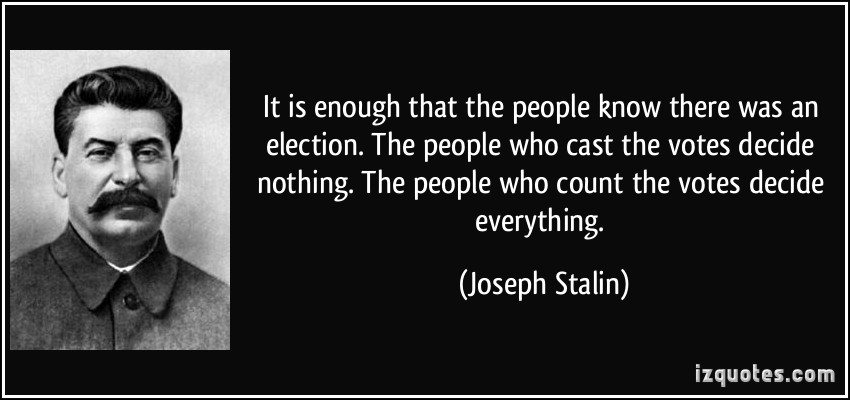
It was no accident that Janis adapted Groupthink from this thinly disguised picture of life in Stalin’s Soviet Union, where the sense of a ‘group mind’, personified in ‘Big Brother’, was ruthlessly reinforced by means of endlessly repeated slogans, and ritualised ‘hate sessions’ directed at anyone daring to dissent in any way from the party’s line
And so we witness what is known as ‘virtue-signalling’ – the desire by people to highlight a view to demonstrate that they side with those who they consider to be morally ‘virtuous’.
But even more, it allows them, often anonymously, to vent personal abuse at anyone expressing contrary opinions.
It is thanks to social media, and to this new aid to the contagious effect of politically correct Groupthink, that we have seen the emergence of what has been one of the most shocking products of the entire saga.
This was the movement to create so-called ‘safe spaces’, where students could be guaranteed protection from anything which contradicted their rigid views on all the issues of the politically correct lexicon.
By the time the ‘safe space’ movement crossed the Atlantic and swept through British universities around 2015, the list of issues on which students wanted such protection had broadened from race and gender to anything from support for capitalism to ‘climate change denial.
Under their ‘no platforming’ principle, they sought to ban any lecturers or visiting speakers whose views they considered offensive.
They also demanded the right to be given ‘trigger warnings’ if a set book contained passages that might be found ‘disturbing’, such as Scott Fitzgerald’s The Great Gatsby, because it includes scenes of ‘violence by men against women’.
And they condemned as ‘cultural appropriation’ any ‘patronising’ Western borrowing of the customs or clothing of other nations.
For example, calling for canteens to stop serving Tunisian stew and the students’ union at the University of East Anglia banning the playful wearing of Mexican sombreros.
It was this absurd wish to be protected from anything that contradicts their own rigid ideology that caused these ultra-sensitive souls to be ridiculed as ‘snowflakes’ –because, as delicate individuals, any slight increase in temperature will see them melt.
But the ultimate irony is what happened to that central principle of political correctness.
These new victims who were seen as needing official protection were the mainstream ‘snowflake’ students themselves – not the traditional minority victims whose interests they claim to hold so dear!
Far from liberating themselves from the ‘repression’ and ‘prejudices’ of the 20th Century, Groupthinkers have created for themselves – and indeed, imposed on us – a whole new social and psychological prison founded almost entirely on make-believe.
In fact, they swapped what they considered to be one set of intolerant ideologies for another. Could anything be more ironic?
Groupthink: A Study in Self Delusion © The Estate of Christopher Booker, 2020; Editor © Richard North, 2020
Extracted from Groupthink: A Study In Self Delusion by Christopher Booker. It is published by Bloomsbury Continuum on March 19, priced £20.
And since 1987 – or whenever I first heard the phrase, “politically correct’ I’ve been fighting it and its proponents, as per this fine – if painfully obvious – article.
I utterly, totally and vehemently despise the police. I grew up respecting them but over the last 20 years I have grown to utterly loathe them and everything that they represent.
No man, or woman has the right of authority over any other man or woman, without that individual’s consent. Those who do so, without the given consent are tyrants. The police are now a tyrannical, policy enforcing, gang of thugs.
The police, especially in the UK, truly do not realise how hated they are. I would never go to the aid of any policeman/woman, regardless the situation. They are utterly despicable, every single one of them.
“Surely not, there must be some good police” again, this is like the good Jew, bad Jew situation. They don’t exist. Anyone, who wants to join the police and enforce law upon people they have no right to, is a tyrant. “But the law is the law” you hear people prattle. And what happens when the law states: “Anyone who assaults a paedophile, regardless of their actions will be given a hefty prison sentence?”
The idiots in society fail to understand, in their blind obedience to ‘The Law’ that laws are written by powerful individuals for the subjugation (and most likely theft of their moneys) of the public.
Britain used to pride herself on freedom of speech, freedom of expression, not taking herself too seriously, doing the right thing and regardless of political affiliation, allowing logical and respectable discourse between said parties.
Now it’s the complete opposite.
And who was behind all the changes? Cultural Marxism? And that’s from where and what minority group?
Nothing changes.
“It’s not the Jews” is the mantra, that certainly ‘the usual suspects’ on here will post.
IT’S ALWAYS THE JEWS!!!!
You think it’s bad now?
You ain’t seen nothing yet. Pick up a copy of the Gulag Archipelago by Aleksandr Solzhenitsyn to see where your society’s headed.
“I want you to stop being subhuman and become ‘yourself’. ‘Yourself,’ I say. Not the newspaper you read, not your vicious neighbor’s opinion, but ‘yourself.’ I know, and you don’t, what you really are deep down. Deep down, you are what a deer, your God, your poet, or your philosopher is. But you think you’re a member of the VFW, your bowling club, or the Ku Klux Klan, and because you think so, you behave as you do. This too was told you long ago, by Heinrich Mann in Germany, by Upton Sinclair and John Dos Passos in the United States. But you recognized neither Mann nor Sinclair. You recognize only the heavyweight champion and Al Capone. If given your choice between a library and a fight, you’ll undoubtedly go to the fight.”
― Wilhelm Reich, Listen, Little Man!
___________________________________
“A group experience takes place on a lower level of consciousness than the experience of an individual. This is due to the fact that, when many people gather together to share one common emotion, the total psyche emerging from the group is below the level of the individual psyche. If it is a very large group, the collective psyche will be more like the psyche of an animal, which is the reason why the ethical attitude of large organizations is always doubtful. The psychology of a large crowd inevitably sinks to the level of mob psychology. If, therefore, I have a so-called collective experience as a member of a group, it takes place on a lower level of consciousness than if I had the experience by myself alone.”
― C.G. Jung, The Archetypes and the Collective Unconscious
_________________________________________
“We had no real goals because we had no sound view of man’s nature and destiny. We had feelings and emotions, but no standards by which to chart the future.
……….
We were not aware of the tight web of power which set the stage for molding our opinions.”
– Bella V. Dodd, Ex-Communist, School of Darkness
A prime example of the latest craze becoming the latest cray-cray. Blue nails???
Maybe bitten by a woke zombie???
There can no longer be any doubt that those who think they have a right to rule us are totally insane. They have to go if Humanity is to survive.
Also, the job of the police is to enforce this lunacy. They too have to go if Humanity is to survive.
If I harm someone else, I need to be stopped. If I’m harming nobody, I have an absolute right to be left alone. We don’t need a central government. We are perfectly capable of governing ourselves and of policing our own communities if and when this becomes necessary.
Just look at what they’ve done to infantilise our language. Today I saw “poo bags” on sale in a local shop. Since when has excrement (dung, shit, crap etc) become “poo”, formerly a very young child’s reaction to an unpleasant smell? It was never used to refer to the source of the smell.
I found myself today. I looked in the mirror and there I was.
Last week I found my feet. They’d been at the end of my legs all the time.
Just some examples of the kind of thing we hear all the time from those that lack any kind of education.
In the past we might have said “eventually I gave in and allowed … ” (whatever).
Now those that mis-heard the term and failed to understand it would say “I caved in …”.
Perhaps I’m just a relic from the past, but having had the benefit of a proper education, albeit in the state system available to all, I find it sickening to witness the deliberate destruction of our language.