
Alexandra Topping – The Guardian Feb 14, 2020
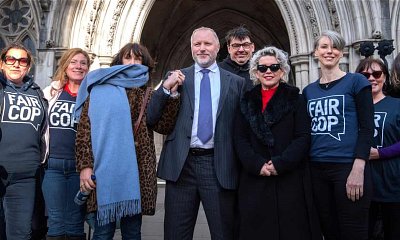
Harry Miller stands outside the high court after being acquitted.
Police officers unlawfully interfered with a man’s right to freedom of expression by turning up at his place of work to speak to him about allegedly “transphobic” tweets, the high court has ruled.
Harry Miller, a former police officer who founded the campaign group Fair Cop, said the actions of Humberside police had a “substantial chilling effect” on his right to free speech.
Miller, 54, from Lincolnshire, said an officer told him he had not committed a crime, but that his tweeting was being recorded as a “hate incident”.
In a strongly-worded judgement, Mr Justice Julian Knowles said the effect of police turning up at Miller’s place of work “because of his political opinions must not be underestimated”.
He said: “In this country we have never had a Cheka, a Gestapo or a Stasi. We have never lived in an Orwellian society,” he said.
But trans rights activists reacted with disappointment to parts of the judge’s ruling. Helen Belcher, co-founder of Trans Media Watch, said trans people would fear “open season” on them as a result. She added: “I think it will reinforce an opinion that courts don’t understand trans lives and aren’t there to protect trans people.”
Knowles rejected a wider challenge to the lawfulness of the College of Police guidance, ruling that it “serves legitimate purposes and is not disproportionate”. The guidance defines a transgender hate incident as “any non-crime incident which is perceived, by the victim or any other person, to be motivated by a hostility or prejudice against a person who is transgender or perceived to be transgender”.
Speaking outside the Royal Courts of Justice after the ruling, Miller called it “a watershed moment for liberty”.
Miller posted a number of tweets between November 2018 and January 2019 which he said formed part of the debate about proposed changes to the Gender Recognition Act 2004.
The tweets included: “I was assigned Mammal at Birth, but my orientation is Fish. Don’t mis species me.” Miller also tweeted: “Transwomen are women. Anyone know where this new biological classification was first proposed and adopted?”. He later wrote that the statement was “bollocks”.
Miller also retweeted a poem by someone else on Twitter which appeared to be directed to a trans woman and used the term “stupid man”, making a derisive reference to a trans woman’s genitalia.
On the same day, Stephanie Hayden, a trans woman, has won her case against a woman who called her a “pig in a wig” and made multiple Twitter accounts to send her anti-trans messages. The court found Kate Scottow guilty of persistently making use of a public communications network to cause annoyance/inconvenience and anxiety at St Albans magistrates court.
In the Miller case, the judge ruled that there was no evidence Miller’s tweets “were ‘designed’ to cause deep offence”, adding that: “The tweets were not directed at the transgender community. They were primarily directed at the claimant’s Twitter followers.” The tweets were lawful and there was not “the slightest risk” that he would commit a criminal offence by continuing to tweet, he ruled.
Knowles stressed “the vital importance of free speech”, saying it included “not only the inoffensive, but the irritating, the contentious, the eccentric, the heretical, the unwelcome and the provocative”.
In his judgment, Knowles said: “I conclude that the police’s actions led him, reasonably, to believe that he was being warned not to exercise his right to freedom of expression about transgender issues on pain of potential criminal prosecution.”
The judge also emphasised he was not “concerned with the merits of the transgender debate”, adding “[t]he issues are obviously complex”.
At last a judge who is actually doing his job fairly. Hope there are more such verdicts as he is correct, we have never had a Gestapo and hopefully never will.
The judge said “we have never lived in an Orwellian society”…..
To test the veracity of this statement by the judge,who is very likely to be a freemason….try setting up a Nationally oriented political party…..the British Secret Police will be sending in their agents in very short order.
Even the police in Britain do this….there was the infamous case of an undercover policeman getting one of his targets pregnant.
What about the miners strike decades ago….where soldiers put on police uniforms to control demonstrators.
Britain has the highest number of close circuit TV cameras in the world!!…. useful for identifying terrorists which the Orwellian British government has kindly imported to kill native citizens.
So this judge is talking through his arse….which is why Assange is now held in permanent detention,a crime in itself.
Sadly, all this article empathises is how the UK police are merely enforcers of tyrannical policy and every reason why they are and should continue to be hated.
A friend’s door was nearly kicked in, with glass smashed and the police didn’t want to know. They’re far more interested in warning and addressing people who make non politically correct statements on the Internet. I wouldn’t go to the aid of any policeman/woman regardless of the situation.
People fail to realise that the police are not there for them, but to protect the elites. The only reason they get involved with the public is other than arrest them and have them taken to court (where the state can steal from them) they have to be seen to be worthy of being paid through the taxation of the public purse.
However, I must point out that you are clearly a fool if you post on twitter or Facebook. They were created solely to criminalise freedom of expression. I’ve never posted on neither, nor ever will. Everything you write will be used in a court of law against you.
Stupid is what stupid does.
The police are a gang, a criminal gang, working for the bankers and enforcing their communism on the people of the west. And they’re letting them. Far more interested in movies, football, idiot celebrities and soap operas than saving their nation. The police can lock up every one for all I care. It might wake them up.
It takes a special kind of **** to be a policy enforcer. You have to be a real, sadistic bastard to do that job. The police ARE the enemy of the people and always have been.
Well if the police are a gang…..what does that make the Secret Police…MI5……Actually they have been licenced to murder citizens by the criminal elites…that’s why the files relating to Dr David Kelly the weapons inspector have been put under lock a key for the lifespan of the average citizen.
So the British Secret Police are ALSO serving the interests of the elite…..
The judge on this case maybe trying to counter the growing opinion amongst the public that Britain is becoming a police state.