
Finbar Anderson and Roland Oliphant — The Telegraph.co.uk Jan 5, 2020
—
Hundreds of thousands of Iranians turned out to pay their respects to General Qassim Soleimani on Sunday as Iraq’s parliament voted to expel US forces from the country over his assassination in Baghdad.
Iraqi MPs voted in favour of a resolution calling for an end the presence of foreign forces in the country, paving the way to remove about 5000 US troops deployed there and dealing a potentially serious blow to American influence in the region.
The vote came after Adil Abdul-Mahdi, the acting prime minister, told an extraordinary session of parliament he had a meeting scheduled with Gen Soleimani on the day he was killed and called the assassination “unacceptable.”
The US military mission is in Iraq on the basis of a letter of request from the Iraqi government in 2014 to help fight Islamic State as part of the international coalition, but there is no formal status of forces agreement.
Although the caretaker prime minister may request US forces to leave, it is not immediately clear how quickly the resolution may be enforced.
The influential leader of the Quds Force of the Islamic Revolutionary Guard Corps was killed on Friday in a US airstrike as his convoy left Baghdad airport.
American officials say they killed the general, who was in charge of Iran’s main expeditionary covert warfare unit and is believed to have coordinated terrorist attacks across the region, to prevent attacks he was allegedly planning against US personnel.
Iran has described the attack as the illegal murder of a national hero and is widely expected to retaliate by striking US assets and allies, raising fears of a regional war.
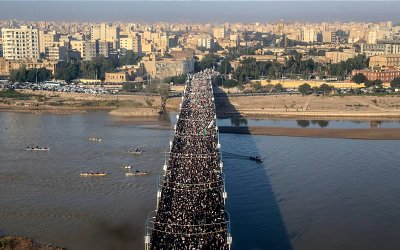
An honour guard paraded as Soleimani’s remains were flown to the southwestern Iranian city of Ahvaz, a key battlefield in the Iran-Iraq war in which he first rose to prominence, early on Sunday morning.
The flight also carried the bodies of five other Iranian Revolutionary Guards and an Iraqi militia commander who were killed with him.
State television showed vast crowds of people, many dressed in black and beating their chests, thronging the caskets as they were driven slowly through the streets of the city.
Soleimani’s body was flown to Mashhad, a shrine city in northeast Iran, for another public procession later on Sunday. It will be taken to Tehran and the holy city of Qom on Monday before being finally buried in Soleimani’s hometown of Kerman on Tuesday
The scale of the crowds, which clogged streets for miles, dwarfed anything seen in Iran since the funeral of Ayatollah Khomeini, the founder of the Islamic Republic, in 1989.
Although Iran’s regime is known to order people onto the streets for pro-government demonstrations, they seldom muster more than a few thousand.
Military tensions continued to rise across the region over the weekend.
A rocket fell on Saturday evening inside the heavily fortified Green Zone, where the US Embassy is located, and two were fired at the Balad air base north of the capital, where US troops are stationed.
Iraq’s military said that no-one was killed, and there were no immediate claims of responsibility, although Kataib Hezbollah, an Iraqi pro-Iran militia, had warned Iraqi security forces to leave US military bases by Sunday afternoon.
The US-led coalition against the Islamic State group, which includes 500 British troops based in Baghdad, on Sunday halted training and support operations in Iraq amid concerns over security.
Mr Trump said on Saturday evening that the United States would hit back if Americans or US assets were targeted by Iran.
But he was immediately accused of planning to commit war crimes when he said on Twitter that he had drawn up a list of 52 Iranian sites “at a very high level & important to Iran & the Iranian culture, and those targets, and Iran itself, WILL BE HIT VERY FAST AND VERY HARD.”
Javad Zarif, the Iranian Foreign Minister responded by saying Soleoimani’s killing was a “grave breach” of international law and that “targeting cultural sites is a WAR CRIME.”
He added: “A reminder to those hallucinating about emulating ISIS war crimes by targeting our cultural heritage: Through MILLENNIA of history, barbarians have come and ravaged our cities, razed our monuments and burnt our libraries. Where are they now? We’re still here, & standing tall.”
Mike Pompeo, the US Secretary of State, said on Sunday that the US would only strike “lawful” targets.”
Iran is home to 24 UNESCO World Heritage sites.
The 1954 Hague Convention for the Protection of Cultural Property in the Event of Armed Conflict, which the US has ratified, forbids parties to conflict from attacking cultural property. Such sites could be targeted if they are being used for military purposes.
The US Department of Defence’s law of war manual states cultural property “should be safeguarded and respected.”
The European Union’s foreign policy chief on Sunday invited Mr Zarif to Brussels for talks designed to defuse the crisis.
Josep Borrell told Mr Zarif during a phone call that diplomacy was the only way out of the crisis and reiterated support for the 2015 nuclear deal, his office said in a statement.
The move reflects existing rifts between the United States and its European allies, including Britain, over Mr Trump’s hard line Iran policy, including his decision last year to withdraw the US from the nuclear agreement.
Dominic Raab, the UK’s foreign minister, urged a de-escalation of tensions on Sunday, saying “We do not want to see a major war in the Middle East,” but added that Soleimani had been a “regional menace” and he understood the Americans’ position.
Labour MP Keir Starmer, currently favourite to win the party’s leadership contest, criticised the killing, calling it the “unilateral act of an irrational and erratic president.”
The israelis who were behind this must pay a big price
and the UK is full of muslims thanks to jews and americans
take your bags and leave the UK as well
I would like to bring to people’s intention that a featured writer on this site has exposed as a Zionist hack:
https://centralbankinginsanity.wordpress.com/2020/01/04/christian-michael-synder-is-another-rotten-fruit-on-the-tree-of-christ/
“For all those who think Michael Snyder is some patriot who writes the popular ‘Economic Collapse Blog’ think again. He is 100% Zionist shill and probably a Jew (Snyder is a very Jewish surname). He might be a crypto Jew like Makow – a Jew turned Christian who is still genetically a Jew and thus his logic as illustrated in his latest article.
Michael Snyder quote; “The world is most definitely a better place without Iranian military chief Qassem Soleimani. He was a butcher, a murderer and a despised international terrorist. All over the globe, people are celebrating his death…”
All three statements in the above quote are false, the world is worse off, Soleimani was driving the Ziosnakes out of Iraq and destroying ISIS (which BTW was beheading Christians – which Synder says he is!) and people all over the globe are mourning his death as this post shows.
Humm… I hope ?? That I’m wrong ? But I think, that 2020 will be an “interesting Year”?
Like everyone else, one day Trump will die too and we all would like to compare his funeral to Qasem Suleimani’s funeral!
The USA bases in Syria Iraq and Afghanistan, are only there asa base to attack iran
for the jews.
It beats me why Americans want to die for israel
but i am assured that they do.
The US Senate promised wars on 7 Middle east countries
strangely these countries refused rothschild banking, e g interest piled upon interest upon interest, so the jews get stupid americans to go in bomb the shit out of them and they these countries have to go cap in hand to rothschild and the jews for loans to rebuild, simple !
Make no mistake these wars are about installing rothschild banks, when Hitler put Rothschild in prison and took over the economy for the German nation and gave them the highest living standard in the world, this was the real reason for the war on Germany
We will leave the uk if you give us back what you took from us John cross.