
Paul Kersey – The Unz Review Oct 25, 2019
Previously on SBPDL: For the West: An Interview with K.M. Breakey, Author of the Must-Read “All Thy Sons”
 K.M. Breakey was born in Toronto & educated at Simon Fraser University in Vancouver. He received a degree in Mathematics & Computing Science in 1992 and enjoyed a long career in Information Technology. In 2016, he turned full attention to writing with the success of his third novel, Johnny and Jamaal. He sees fiction as a tool to disseminate truth and expose lies. Previously, he was interviewed by Paul Kersey regarding his latest book, All Thy Sons. As he told Kersey, “I try to authentically capture today’s distressing realities in my novels – the absurdity, the obliteration of freedom, the demonization of whites.”
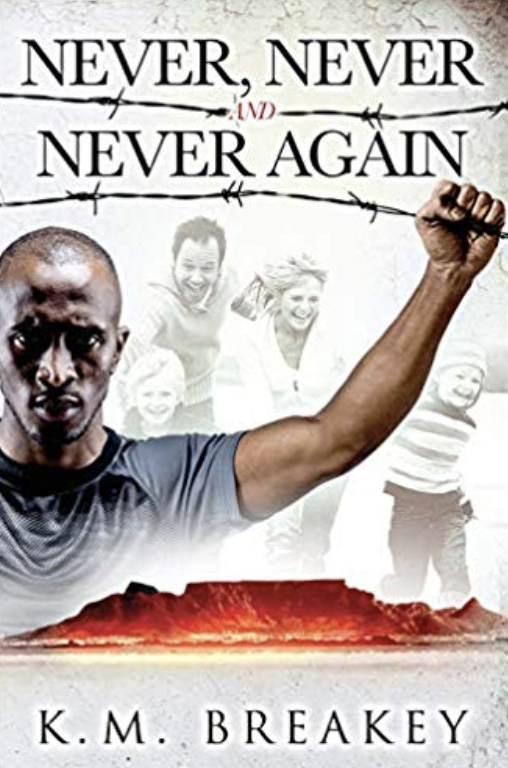
Today, we look at his book Never, Never and Never Again. It is a fictional look at life for white people in the aftermath of the handover of South Africa to black rule. And it offers a warning for those in Europe, Australia, the USA and Canada for what is coming… be sure to pick up a copy of this outstanding work!
1. It’s been 25 years since South Africa’s historic election, allowing the ANC to take power: what observations do you have on democracy and how it has worked for the Rainbow Nation?
In 1994, Nelson Mandela stated: “Never, never and never again shall it be that this beautiful land will again experience the oppression of one by another.”
At the time, many believed him. Something about Mandela. An aura. A mystique. He used it to his advantage at every turn. He also used uprisings and violence, but there was certainly no need to harp on that. Instead, world leaders celebrated, and global media swooned. It was the end of white minority rule and the start of something amazing. South Africa’s true potential would finally be realized. Sit back and watch greatness unfold.
Unfortunately, that didn’t happen. In 2019, South Africa’s an embarrassment. Mandela’s vision was a hoax. A fairy tale. Anyone who says otherwise is lying or a fool. Everything’s failing – the water supply, the grid, the financial system, roads, political civility, law and order.
Yet 4.5M whites remain – deserted, defenseless, terrified – and the media says not a peep. How much longer can this go on?
2. Tell me about your novel on South Africa? Why would a Canadian be interested in writing about this nation?
In late 1970s East Vancouver, I became aware of a tribe of whites living full and fruitful First World lives on the dark continent. They had skyscrapers and freeways and hospitals. They worked in offices and took vacations with family. They were like us, but in Africa.
I was fascinated. How could you not be? I felt a kinship and a profound curiosity. This was pre-Internet but somehow, I’d heard tell of the violence. In whispers. I knew in my heart these people were unsafe. I knew they were in great danger. I think everyone did.
But still. Why on earth would that 14-year old kid in 1970s East Vancouver worry about White South Africans? Simple. They were my cousins – culturally, ethnically, however you slice it. It’s heresy to say in 2019, but it’s true. Cultural indoctrination had yet to kick in. I was still thinking rationally.
Today, I worry more than ever because we’re seeing the true nature of the heathens that destroyed this once-prosperous country. Black politicians compete to show who hates whites the most. They’re showing the world what’s in their hearts – revenge, envy, rage.
When all the whites are gone, they’ll turn on each other. Everyone knows it.
3. What did you hope to accomplish with your book on South Africa, Never, Never and Never Again?
My books are fiction, but they tell forbidden truths. Don’t blame me for what my characters say .
I don’t know another English-language novel that tells the Afrikaner story. Michener’s epic came close, but he left off in ’79 just when things got interesting. I claim Never, Never and Never Again fills the void. It draws attention to a people in grave danger. White South Africans are lovely, hardworking people. And they’re trapped in hell.
As I wrote the book, I followed the appalling descent. A few stories stuck. Cherize Smuts speaking through the anguish of losing parents and grandparents. The brutal rape and murder of Hannah Cornelius. There are thousands upon thousands more, for those brave enough to look.
How could I not write this book? I sleep better having done so, but the story’s not over. Will the slow road to hell continue? Or is a cataclysm coming? A slaughter, a war, something? Regardless, liberals will put hands in the air and say didn’t see that coming, even when “respected” black leaders openly discuss it, and have done for years.
How to save the white South African? Relocation? A self-governing state? Afrikaners are durable and resourceful, and they’ve surprised in the past. Many times, they’ve won against great odds. Their story’s not over, but the odds of victory seem astronomical. We can only pray for a happy ending.
4. Looking at BEE (official government affirmative action/discrimination against whites) and the continued attacks on white farmers, what do lessons does post-Apartheid/democratic South Africa have for the western world?
I recently had lunch with a South African ex-pat, a guy well-versed in the joys of BEE. He spoke of ill-equipped blacks assuming positions of skill and responsibility. Their primary concerns were the pay, the perks, the car they’d get. It was dressup time. Playtime. They had little interest in their duties, nor the ability to carry them out.
This isn’t news. It’s been happening for years and it explains the breakdown of everything. A thin layer of competence – mostly whites – sits behind the façade and tries to hold it together. This layer’s getting thinner all the time.
In terms of lessons learned, the obvious is this – our instincts are often right. These were primitive, tribal people. Job titles changed nothing. Nor did fancy suits and flashy cars. Did we not know in our hearts this ridiculous experiment would fail?
And has Western Man learned anything? Did South Africa learn from Rhodesia? I think of those adventurous and industrious Rhodesians – deserted by Britain, left to fend off savages. God bless them, they gave it a helluva whirl.
People of the West assume civilization’s the natural order. They believe it’ll go on forever. At one time, Rhodesians had the same expectation. Safety can vanish overnight. Everything can vanish overnight.
5. I understand your next book’s set in Ireland. Are you able to share any details?
Think of Ireland and you think pints with friends and having the craic. Of green fields and castles, and places like Donegal and Galway and Cork. It’s a land of welcoming people who’ll give you the shirt off their back.
But Ireland’s had its share of fighters, too. These lads don’t surrender land easy. Never have. This island’s their inheritance, and they’ve shed blood to protect it for a thousand years. They never once flinched or cowered.
How times change. Ireland’s in trouble. They’re under the grip of a vicious strain of Progressivism. They seem desperate to catch up with Britain, Sweden, and Germany. Won’t be long at the rate they’re going.
Who thought it was a good idea to flood Irish towns and villages with Third World migrants? The usual suspects of course. It certainly wasn’t the Irish, not counting the scoundrels in Leinster House. For those in the frontlines, tis a jarring disruption to a way of life that’s changed little in a thousand years. Some call it an act of war.
Is it too late to save Éire? They say the ethnic Irish’ll be a minority in ten years. A hardy band of patriots is working to change that. They’re sticking their necks out, channeling Pádraig Pearse and James Connolly.
My next novel, set in modern-day Ireland, follows the journey of Eamon Clarke – sportsman, television personality, national treasure. Above all, proud Irishman. But the land Eamon loves is shifting underfoot. Everybody feels it.
How, he wonders, can a nation of fighters succumb so easily? They’d suffered through hardship far worse than a nasty bout o’ liberalism, right? Eamon vows to fight – to risk everything for his people. Unfortunately, he has no idea what he’s up against.
Coming November 2019.
I am one of the 4.5 million whites that remained and I don’t feel deserted, defenceless or terrified. Thank you.
Is there any hope at all? I have heard that there will be four and a quarter BILLION Black Africans before the end of this century – all wanting in to Europe! Will Europe turn Black as Gaddafi predicted? Looks like it.
An old Boer who was a prophet, known as The Seiner, said that Southern Africa would become the refuge for White people in the end!
Hitler is said to have consulted the blind BabaYar in Rumania. He was very distressed because she told him that the Vatican would become the new Caliphate. Or so they say.
I am never sure one should make such things more public than they are because it may make it more definite that it will happen – but I see little hope for Europe and the beautiful England.
As for Ireland – they can surely SEE what is happening, yet they do not take advantage of their isolation to keep themselves IRISH! They make NO SENSE.
As for what he has to say about South Africa – he is completely right. It is envy and spite and idiocy which causes the destruction of a country where no one went hungry, where it was peaceful and happy, almost placid until that fool Mandela was used so cleverly by the Jewish media to become the saint he was not. He never attacked any hard targets with his bombs – only shopping centres! What a cowardly fool with a vicious, disgusting wife. Her invention of “necklaces” are being used a lot these days, for trivial disagreements between people in the townships – which are no longer clean orderly places! They are all, without exception, filthy and violent.
South Africa lost it’s sovereinty when Mandela took over. It is no longer a sovereign country but is a corporation – so I am told – listed as a business on the NYSE abd the people and the minerals underground belong to that corporation! That is, the peeople are actual slaves, legally speaking.
The minerals used to belong entirely the tribe on that land – in the time of apartheid and the development of the Bantustans. That is, each tribe had their own land, clear and free to do with as they pleased – with help always available from the White Government, that vilified Afrikaans Government – and they owned the minerals under their land completely free anc clear.
In other words, they were free people on their own land – their “Bantustan” (it was all designed to be much like the Swiss system) and they owned everything on that land and those precious minerals under their feet.
Now they own nothing at all – but the bantustans created by the Apartheid Government are still intact! They have not changed the boundaries at all –
Furthermore, South Africa is a member of the Commonwealth, which means that South Africa has to vote as insructed by the British Government at the UN!
That must be why the foolish Zuma betrayed “his friend” Gaddafi and voted for the bombing by NATO of the beautiful Libya.
And that is why Europe is turning black!
South Africa is having an orgy of killing – as cruelly as only Africans know how. They are burning people in the streets, especially hating Nigerians who are the drug pushers. It is goig on all the time – they pour gasolin on to someone and throw fire at them and they writhe in full view whle surrounded by black mobs chanting and dancing and suer exited,
Africa is a savage and dark place. Anyone who tries to pretend therwise is simply sickly sentumental and STUPID. They LOVE killing – as cruelly as possible!
Sadism is their greatest pleasrue – and Mandela was at least as sadistic as any – and terribly stupid because of his envy.
Envy is the problem, There is a little fool called Julius Malema. He spends a lot of money on shiny cars, including an Austin Marten (the first service costs 23 thousand punds!) and three others. He lives in a White man’s style mansion, very expensive suits and shoes and shirts – and he even has himself and his wife photographed on a boat, for the South African magazines, aping the White man – the RICH White man.
In the meantime the Zulus and others are reverting to cannibalism!
There is a very intersting piece on The Saker this past week, about how a certain Pondo chief wrrote to the Tzar in Russia, begging him – very politely and in most civilised tones, to come and protec them from the British.
I wouldn’t trust a white south African as far as I could throw his antique side table off the back of the removal truck. Where the f, do they get the money?
Christ my great grandfather fought those arrogant creatures and although they were good old grandads crew could outwit them with a shovel. Diggers got their name fighting that lot for empires sake. Breaker Morant ring a bell.
All these generations later I fully understand the stories handed down about how arrogant and supreme thinking they are.
My local zone is filling up quick with them and now they’re entering politics in very liberal tones.
Na the Irish and south African whites are a totally different breed to try and super state all whites is f, in crazed and absurd.
Christ I have a white south African doctor who admitted to smuggling codeine tablets in his container because the south African drugs are far stronger. When customs caught him all they did was take the tablets not all by the way and he was never charged?
Look black south Africa get your shit together we don’t want these haughty zealous types here and we are stuck with them now, same as every other immo in town black, white, yellow, Brown or f,in Martian. No good in any of it they all f the place.
Maybe the south African blacks are smarter than the racists make out.
I got no doubt about the anti white agenda installed by multiculturalism with Mr ju as the usher to deny it is just stupid but fairdinkum the beauty of the whites is in their diversity to super state us saying we are all the same is denying the reality also.
To be true only a Martian looking down on the planet as a whole has the right to say multiculturalism exists we down here can say what a mess the euranglolanders have caused themselves and I bet the Martians wouldn’t argue.
dunno – I am not sure which planet you are on but you talk a load of tosh. not trust a white south African but you say nothing as to who you would trust. pull your ostrich like head from the sand and smell the coffee for a change. if it was not for the whites south Africa would not have risen to a first world country status with an A rating in the first place. since 1994 and the hand over to mandela, the country rating has sunk to junk status, there is continuous outages, law and order is failing and infrastructure deteriorating. pre independence and under the president P W Botha south Africa was gradually integrating the various tribe which was working perfectly until the corporations and uk became involved. one cannot overnight expect someone not used to European ways to suddenly become westernised. so wake up. Europe talks of multiculturalism and integration i.e. open door policy allowing refugees north africans, non Christians with different cultures and religion is not working and creating resentment with the locals. the rapes and murders occurring in Sweden, germany etc are legion. yet these two countries have a two tier legal system. refugees committing rape are let off but a white is incarcerated. there are 70 no go areas in Sweden that the police will not enter. So please see the woog for the trees
“I am one of the 4.5 million whites that remained and I don’t feel deserted, defenceless or terrified. Thank you.”
Maybe the Rawandan genocide of Tutsi’s at the hands of Hutu’s didn’t happen either?
Tutsi’s are Nilotics, and hence are lighter, taller and more attractive relative to the shorter and more primitive looking Hutu/Bantu peoples.
If Bantu’s massacred fellow Negroes (up close and personal – with machetes) out of rage and jealousy, then what makes you think you are immune?
Liberals, whistling past a graveyard, and in denial of reality, is always a thing to behold. White liberals are especially dangerous to the race.
Those desiring a realistic picture of the Blacks found in South Africa, in all their ethnic splendor and moral superiority, will find that and much more in the less fantastical novels of H. Rider Haggard. Best of lot imho is “Nada The Lilly.
The author gives a human and often sympathetic portrayal, BUT he does not overlook or dowplay the fact that these people are not like us and are, in fact EXACTLY as Dr. Albert Schweitzer described them — look that up. Not people you would allow to make any life or death decisions about your future or safety.
Haggard’s novels are mostly available free, at Operation Gutenberg and elsewhere.
“The negro is a child, and with children nothing can be done without the use of authority. We must, therefore, so arrange the circumstances of daily life that my natural authority can find expression. With regard to the negroes, then, I have coined the formula: “I am your brother, it is true, but your elder brother.”
— https://en.wikiquote.org/wiki/Albert_Schweitzer