
Introduction – Aug 4, 2019
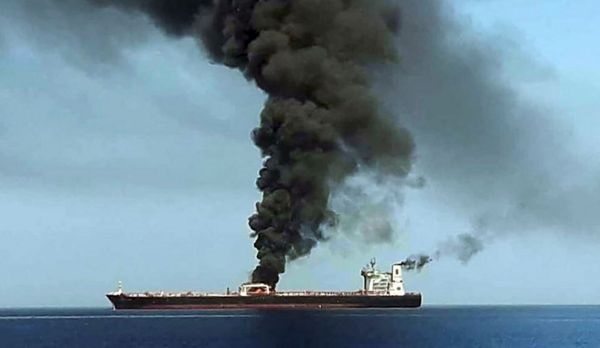
Suspicions have been voiced that the recent attacks on tankers in and around the Straits of Hormuz were staged as a pretext to create a naval force to blockade Iran. Click to enlarge
The notion that the U.S. wants to blockade Iran, outlined below, makes perfect sense. Pushed by the Zionists, the U.S. is doing all it can to weaken and undermine Iran.
Predictably, Britain has already sent ships to the region and so too has South Korea, while Australia is reportedly considering “very seriously” a U.S. request that it contribute to a naval force.
As detailed below however, not everyone is buying into the U.S. plan to create a multinational naval force, ostensibly to ‘protect’ shipping in the gulf. So it still remains to be seen whether the U.S. can successfully establish a blockade of Iran. Ed.
US-planned Persian Gulf coalition meant to blockade Iran: Commentator
Press TV – Aug 4, 2019
A political commentator says a United States-planned force seeking to sail in the Persian Gulf would be a prelude to the enforcement of a blockade against Iran.
Author and commentator Nasir al-Omari said on Press TV’s The Debate program on Saturday that although the plan has been presented to the US’s allies as a means of protecting the vessels sailing across the Hormuz Strait, “I think that the world understands that these moves are really intended to be a blockade of Iran.”
“Once you have these warships, then this turns quickly into a blockade,” he said.
The US has said the naval force would be ensuring the safety of foreign vessels sailing through the Strait of Hormuz in the strategic Persian Gulf. However, key Washington allies Germany and Japan have refused to join, and France has expressed reservations.
Omari said the rejection of the American initiative was “a positive indication” that the international community was not rushing toward a confrontation with Iran.
In order to tackle the standing escalation of tensions between Washington and Tehran at its root, he said, one has to aim for the underlying cause of the situation.
“The root problem has not been solved, and that is the sanctions against Iran,” Omari said.
Washington left a multilateral nuclear accord with Tehran and other states last year and re-imposed the sanctions that the deal had lifted. It has since been imposing further sanctions as well.
Keith Preston, an independent journalist and researcher who was also on the program, referred to Japan and Germany’s refusal to be part of the force and said, “The US’s alliances are far weaker than perceived.”
He said Tokyo and Berlin had refused because of Washington’s performance in the past, when it left the nuclear agreement with Iran “against the objection of virtually every US ally” and engaged in “disastrous” regional military interventions.
Blockades make lifer harder for the ordinary people, not the rulers. The Iranian people want peace, the Iranian Mullahs want peace, the Iranian Revolutionary Guard are undecided, BUT THE ISRAEL LOBBY WANTS WAR, so long as Israelis don’t have to fight it. They will leave that to the USA and NATO.