
Julian Borger – The Guardian June 13, 2019
The US military has released video footage it says shows an Iranian military patrol boat approach one of two tankers attacked in the Gulf of Oman, to support the Trump administration’s claims that Iran was responsible.
The blurry black and white footage, taken from the air, shows a small military boat alongside the Japanese-owned Kokuka Courageous, and someone standing up on the prow of the boat to remove an object from the tanker’s hull. The small boat then pulls away from the tanker.
US officials were quoted as saying the boat was an Iranian Revolutionary Guard patrol boat approaching the tanker after it was attacked on Thursday, and the object removed was an unexploded limpet mine. It was unclear whether it was being alleged the Iranian sailors were detaching the mine in order to remove evidence.
Thursday’s attacks ratcheted up tension between the US and Iran, which are locked in a volatile standoff after Washington imposed crippling economic sanctions on Tehran in an attempt to force the renegotiation of the 2015 Iran nuclear deal.
The incidents also added to security fears over oil tankers traveling through the the strait of Hormuz – a chokepoint for the global oil and gas trade – and appeared to have snuffed out a Japanese-led mediation effort between Tehran and Washington.
The US military also released a photo it claimed showed a mine on the side of the Kokuka Courageous and some damage to the hull.
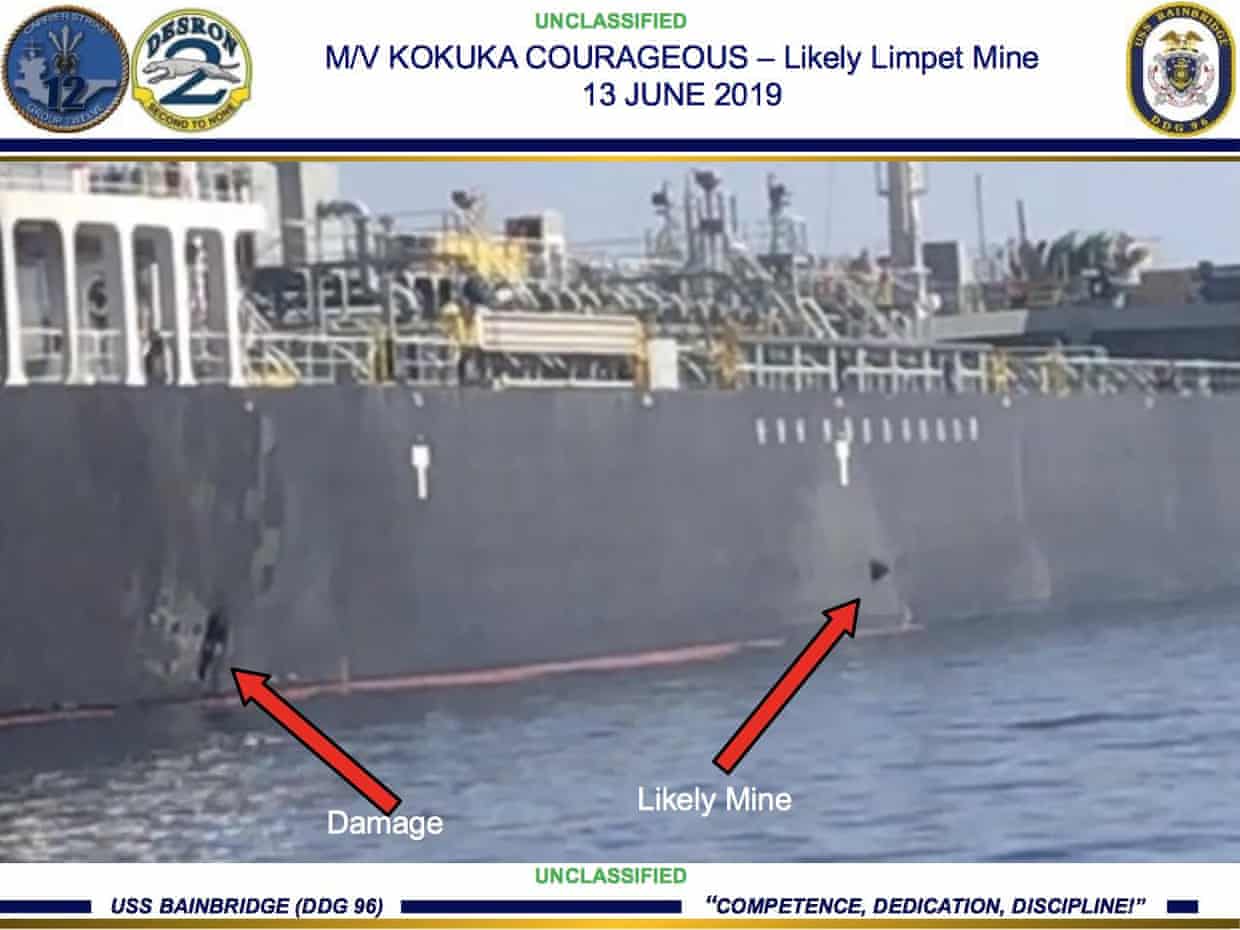
A photograph released by the US military showing damage to the Kokuka Courageous and a suspected limpet mine Photograph: U.S. Central Command. Click to enlarge
The operator of the tanker suggested the vessel was struck by a missile. The crew saw “flying objects” just before it came under attack in the Strait of Hormuz on Thursday, according to Yutaka Katada, president of the Tokyo-based owner Kokuka Sangyo.
The vessel’s crew had spotted an Iranian naval ship nearby, he added, but did not say whether that was before or after the attack, which damaged its starboard side.
Earlier the US secretary of state, Mike Pompeo, said the US believed blasts on the two tankers were caused by the Iranian military “based on intelligence, the weapons used, the level of expertise needed to execute the operation”. He also claimed that the attacks, had such a high degree of sophistication they could not be have been carried out by a proxy.
Pompeo offered no evidence for his claims and took no questions after making his allegations. He said that Iran had been responsible for a previous wave of attacks on tankers last month, but the official investigation into those attacks did not determine who had been responsible. He also claimed a 31 May car bomb in Afghanistan which killed Afghan civilians and wounded four US soldiers, had been carried out by Iran. The attack had been claimed by the Taliban.
Tehran denied all responsibility and its foreign minister Javad Zarif suggested others could be trying to provoke a conflict between Iran and the US.
The incident took place on a day Iran’s supreme leader, Ali Khamenei, bluntly rejected the proposal of a resumption of US-Iranian talks, suggested by Japan’s prime minister, Shinzo Abe, on a visit to Tehran. Abe is widely thought to have had the blessing of Donald Trump in offering to open a channel of communications between the US and Iranian leaders.
But after Khamenei’s rejection and the tanker attacks, Trump followed suit, posting a tweet saying: “I personally feel that it is too soon to even think about making a deal. They are not ready, and neither are we!”
The blasts on the tankers on the Kokuka Courageous and the Norwegian-owned Front Altair pushed oil prices up by 4% and could further raise insurance premiums for vessels operating in the Gulf. Crew members from both vessels were rescued. One of the crew of Kokuka Courageous suffered burns on his hands and was treated by a US Navy medical team
Confirming the involvement of its ships, US Central Command issued a statement warning it would not tolerate any attempt to interfere in their operations but insisted it was not interested in conflict.
It added that the destroyer USS Mason was en route to the scene of the attacks to support the USS Bainbridge, which took in the crew from the Kokuka Courageous.
Saudi Arabia supported Pompeo’s claims. Its foreign minister, Adel al-Jubeir said on Thursday: “We have no reason to disagree with the secretary of state. We agree with him.”
The UK foreign secretary, Jeremy Hunt called the tanker attacks deeply worrying but said Britain would be making its own assessment of responsibility.
Khamenei dismissed the notion of talks with the US, saying in a series of tweets “I do not consider Trump as a person worth exchanging any message with and I have no answer for him, nor will I respond to him in the future”.
He added Iran had no plan to build nuclear weapons, but if it wished to do so, the US would be unable to stop it.
Pompeo said the attacks on the tankers were intended as insult to the Japanese leader.
“Iran’s supreme leader rejected Abe’s diplomacy today by saying he has no response to president Trump and will not answer,” he said.
The US put its allegations before a closed session of the UN security council on Thursday. Iran responded by accusing the US of stoking tensions and mounting a campaign of crippling sanctions.
The United Nations secretary-general, Antonio Guterres, strongly condemned the attacks, warning that the world cannot afford “a major confrontation in the Gulf region”.
Here it is the fasle flag to kick off the w w 3 that israel had been opushing for for so long
It is not in irans interest to war with anyone
The only people who would gain froma war are the jews who own the weapons industries
and wants irans mineral and oil reserves
Libya iraq lebanon etc all bombed for israel by stupid americans
people have forgoten the age old saying from Herodotus
” beware the dirty jew”
FAKE NEWS: FAKE NEWS: I Can Prove This Is Fake!
Take a good look at the photographs. Hey you Americans ARE YOU SO STUPID, OR ARE YOU SO ARROGANT THAT YOU THINK NOBODY ELSE IN THE WORLD KNOWS ABOUT BALLISTIC DAMAGE!
Here is a real photo of how a missile, even a small missile can penetrate many layers of metal and still hold its integrity…LOOK CLOSELY….Look closely at the 18 SECONDS mark. The sager came in from the OTHER side of the whole, see how round it is!.
All missiles hit like that. Now think very carefully people. Do you think that tanker has armor plating like what you saw in that video above? Of course not. I can tell you right now, if a missile did hit that tanker it would have exploded the oil in the tank’s storage holds!
Now look closely at the holes again. You can see they are irregular. They are not circular. That means those holes were made with placement charges. That’s right, it was a “hand made” job. And who do you think has the scuba divers to do exactly that kind of work, hello US Navy Seals!!!
Those charges are very small, that means they were compact. No missile does that kind of damage today on such minor metal like a cargo/petroleum vessel. It had to be delivered by hand. And do you really think Iranian scuba divers swam from Iran to do this! I do believe its the USS Abraham Lincoln that is there, how very appropriate, a US President killed by his wife and the lies the US government to cover it up, if you want to read more click here.
The USS Abraham has a Seal team on board. So you know who really is behind this. But look closely and the irregularly of the blast whole, its not circular. The caption says Limpet mine. NONSENSE. FAKE NEWS. Here is the damage of what real limpet mine does on sheet steel, Goto page 2 (there’s only 2 pages), and you will see what a limpet mine does on sheet metal.
As you can see from the photos in this story by Jim Borger, journalist of the Fake Newspaper known as The Guardian, the holes are irregular, they are not Limpet mines. These charges were very small and there were multiple charges placed, and that could only have been done by hand. Take a good look how close to the water line they are. Suspiciously good match in height to those placed charges on the ship! US Navy Seals, criminals of humanity that need to be brought to justice for war crimes, to The Hague!
More attempts by the United States to start another false war, all because they are becoming more and more irrelevant in the world.
The only real danger is this. The United States is run by a bunch of greedy, power hunger morons. The United States as I have said is a dying super power, and like most vicious animals when they are close to death, they are at their worst and meanest.
Keep it up America. With the way you are shooting yourself in the foot all the time, you are turning into the laughing stock of the world! What a bunch of morons!
One idea worth mentioning is that the Iranians were removing one of their mines placed there by an US/Israeli/British special forces. It would be in Iran’s interest not to get framed for the blast charge.
It would be a piece of cake to acquire and Iranian mine then frame them for the blast.
Such a deception is right in line with what Zionists would do, and let’s not forget that JEW WHORES Pompeo and Trump would sing right along with that narrative.
Everyone i work with says yup dirty jews and stupid americans.
Makes me laugh, the world knows what they are
another false fag to set the yanks on Iran