
Bradley Bowman and Major Liane Zivitski – Defense World April 9, 2020
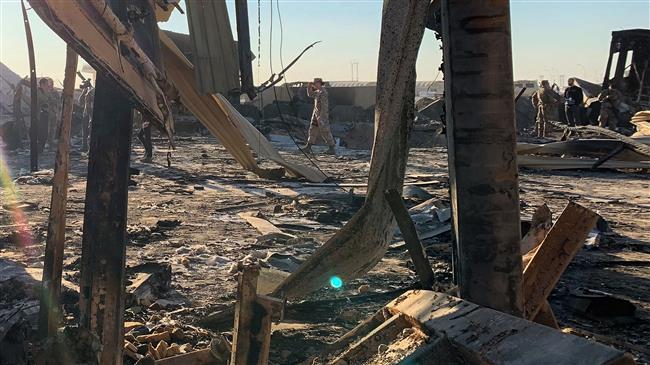
US soldiers clear rubble at the Ain al-Asad military airbase in Anbar province after an Iranian missile strike. Click to enlarge
The Pentagon is deploying additional air defense systems to Iraq to better protect U.S. troops from missile and rocket attacks by the Islamic Republic of Iran and its proxies. The Pentagon is also consolidating troops at larger and better-protected bases, which will save lives and preserve the American combat power necessary to respond to any additional aggression.
The Department of Defense confirmed last week that it deployed Patriot air and missile defense systems to Iraq. The two batteries went to Ain al-Asad Air Base and Irbil Air Base — three months after Tehran targeted those bases with ballistic missile attacks. Tehran took advantage of the lack of ballistic missile defenses, injuring dozens of U.S. troops.
The Patriot systems provide a ground-based air defense capability against a variety of threats, including aircraft, cruise missiles and ballistic missiles like those Tehran launched in January. The Patriot includes a launcher, a radar to track targets, a manned control station and a power generator.
Washington has reportedly engaged in talks with Baghdad since January regarding the deployment. But apparent difficulties in obtaining permission from Baghdad delayed the Patriots’ arrival — leaving American troops vulnerable to ballistic missile attack longer than necessary.
The eviction of U.S. forces from Iraq represents a major strategic objective for the Islamic Republic of Iran, and Tehran has used its extraordinary influence in Baghdad to push for an American departure regardless of the interests of the Iraqi people.
Even though Patriot systems are entirely defensive, the Islamic Republic responded to their deployment by suggesting the U.S. was engaging in “warmongering” that would lead to “instability and disaster.”
Tehran understands that the Patriots limit its options for additional aggression. But it also knows that the Patriots cannot defend against the rockets that the Islamic Republic’s proxies in Iraq have repeatedly lobbed with deadly effect at U.S. and coalition troops.
Accordingly, the DoD has also deployed counter-rocket, artillery and mortar systems to some locations in Iraq. The Pentagon typically relies on these systems to defend the Patriot batteries, but C-RAM systems can also protect personnel from rocket attacks.
Up until recently, however, U.S. troops were deployed all across Iraq in many bases large and small — making it difficult to protect each from rocket attacks.
On March 11, Kata’ib Hezbollah — an Iran-backed Shiite militia also known as KH that operates in both Iraq and Syria — attacked Camp Taji with 107mm rockets, killing an American soldier and airman as well as a British medic.
In response, on March 12, the U.S. struck five KH weapon storage sites.
Two days later, another rocket attack on Camp Taji injured three U.S. service members.
And on March 17, rockets struck a base south of Baghdad hosting U.S. and coalition troops.
These attacks underscore the importance of the U.S. Army’s efforts to develop and field a next-generation indirect fire protection capability that can better defend U.S. service members from rocket attack. The Army should also explore expediting the deployment of the Iron Dome systems it has already purchased.
In the meantime, the Pentagon has vacated several bases in Iraq, consolidating forces on larger and better protected bases that will benefit from the protection the Patriots and C-RAM systems provide.
In fact, over the past month, the U.S. transferred at least four bases to the Iraqi security forces. They include al-Qaim, Qayyarah Airfield West, K1 Air Base and Al Taqaddum Air Base.
Some of the troops will depart Iraq, and some will reposition to other bases in country. Pentagon officials say the base transitions and troop movements are a result of success against ISIS and were long-planned, rather than a response to recent rocket attacks
Regardless, consolidating U.S. troops on bases protected by Patriot and C-RAM systems would afford the Americans better protection.
That is a positive but likely insufficient step.
Tehran is unlikely to stop its use of asymmetrical proxy terrorist attacks that have featured prominently in the regime’s foreign policy since 1979. The economic and coronavirus crises in Tehran may encourage the regime to undertake desperate measures and double down on this policy. That would likely include additional aggression against American diplomats and service members in Iraq and elsewhere.
The Pentagon and its coalition partners in Iraq should make clear to Baghdad that it has a responsibility to prevent attacks. If Baghdad is unwilling or unable to provide such protection, American service members must have every tool necessary at their disposal to defend themselves and to punish additional aggression.
Bradley Bowman is senior director for the Center on Military and Political Power at the Foundation for Defense of Democracies, where Maj. Liane Zivitski is a visiting military analyst. Views expressed or implied in this commentary are solely those of the authors and do not necessarily represent the views of the Air University, the U.S. Air Force, the Defense Department or any other U.S. government agency.
Very surprised to see a piece like this here at Truthseeker.
The US should never have been in Iraq in the first place, and has now been given a clear demand to leave. That is to say even if the American presence in the first instance was not a crime, her failure to leave now is.
No amount of dressing up further aggression embodied in the deployment of more ‘defense’ weaponry will work.
There is no need to defend bases that are to be empty.
And to claim success in defeating Isis when the USA, Israel and France ARE Isis, is simply laughable
Uhh. Kind of like Vietnam. Locals and allies attack US troops who will eventually have to declare victory and leave.
What’s the point in building a castle if you can’t do anything with it. Big toughboy invader Bradley Bowman whines to Bagdad for protection?
“Punish additional aggression”, who’s doing the social distancing walled up in another’s land Bradleyboy pom pom twirler, ra ra sue em.
Ain Al-Assad was attacked by older generation Iranian missiles, though they were equipped wit the latest electronic warfare modules. We’re talking about missiles that have guided warheads, that hit their targets with speeds of 13 Mach or more; that’s about 4.5 kilometers per second! Some even exit atmosphere and launch warhead right from above the target. There is no defense against these missiles. Patriot spectacularly failed Aramco! Assuming systems like Patriot or Iron-dome are effective, they are very expensive and can be easily overwhelmed by multiple simultaneous missile strikes. As Iran’s Supreme Leader said: “The era of hit and run is over!”… surely the Leader of the resistance front in the region does not say things for jest. I doubt Pentagon believes these are all Photoshop”ed” missiles! However the rest of the world should think so!
“Despite sanctions Iran has developed some sophisticated weapons. If it continues to develop its military/industrial capabilities then at some point soon it will be able to challenge Israel and America’s dominance of the region.
Bullies and cowards are at their most dangerous when challenged. Even now the U.S. would be unlikely to prevail in a conventional military conflict with Iran. The best the U.S. and its allies could hope for would be a bloody stalemate. In another decade or so that may not be possible, as Iran may have developed the means to overcome America’s military supremacy.
Make no mistake, there are some genuinely evil people in the Trump administration (Bolton). There are also some vain, easily influenced airheads (Trump). It’s and explosive mix that could have catastrophic consequences.
This is why the prospect of U.S. nuclear strikes on Iran is plausible and why it would appeal to U.S. and Israeli hawks. They could bomb it back into the “stone age” and neutralize an emerging threat to their regional dominance.
Admittedly this may sound alarmist but time is running out and Mike Pompeo and his Zionist allies know it. Ed. (Rixon Stewart)
Iranian Commander: U.S. “Afraid” of Iran
By wmw_admin on July 6, 2019
News Commentary – July 4, 2019
http://www.thetruthseeker.co.uk/?p=191099
———————————
Idiots Driving World to War
And Iran Declares Open Season On Sitting Ducks! – (DISASSOCIATED PRESS)
By Finian Cunningham on July 16, 2019
http://www.thetruthseeker.co.uk/?p=191618
The U.S. can’t get it through their thick heads. They are NOT wanted in Iraq and they are playing fast and loose with Iraq’s sovereignty. A game they have been playing since 1991.
Of course we know who is pulling American strings, don’t we Jarred Kushner. You and all the other pro Israel Zionist neo-cons.