This movie is about a few days in the life of a struggling folk singer in 1960’s Greenwich Village.
For 90 minutes, I was in a time capsule. I was “Inside Llewyn Davis” and I liked it there. Some reviewers describe him as cold but I disagree. He is an artist in a Philistine world. One scene epitomizes it. He hitches to Chicago for an audition with Albert Grossman. He pours his heart into a beautiful melody, only to be told, “I don’t see the money.”
Writer & Directors, the Joel and Ethan Coen (right) lend a Fellini-like quality to the people Davis encounters.
Like their protagonist, the Coen’s didn’t compromise. Althougha critical success, the film has only made $11 million so far.
A steaming turd like “The Wolf of Wall Street“ has earned $92 million to date and got Oscar nominations for Actor, Director and Best Picture. In a society run by coprophiliacs, this stands to reason.
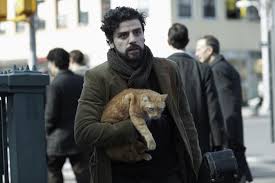
Llewyn Davis is played by a beautiful and talented actor Oscar Isaac. His character is ambiguous ethnically. His sister and some friends are Jewish but his father was a merchant seaman, not a Jewish occupation. The fact that Dave Van Ronk’s autobiography “The Mayor of McDougal Street” provided inspiration for the screenplay may explain this ambiguity.
The movie has a meditative quality. You are in the moment, as when Davis awakes to the sound of a rocking chair and someone eating cornflakes.
Inside Llewyn Davis depicts the fate of beauty in a coarse, brutalized society. The protagonist has nothing but his music and his integrity. He refuses to compromise.
He made me feel that we define ourselves by what we do when no one is looking, when no one can learn what we did. For example, he sang a heartrending song for his dying father who is suffering from dementia. It is unclear how his father was affected by it, except to release his bladder.
Virtue is its own reward. There is no happy ending.
In the final scene, we see the young Bob Dylan performing. Somehow, Dylan knew how tocompromise.

 Writer & Directors, the Joel and Ethan Coen (right) lend a Fellini-like quality to the people Davis encounters.