
News Commentary – November 20, 2011
The story below helps illustrate how the BBC maintains the semblance of ‘balanced news coverage’ while presenting what amounts to little more than disinformation. It does this by excluding key elements in a story.
See if you can spot what’s missing in the report below. It’s a fact of paramount significance but the BBC carefully avoids even hinting at it. If you haven’t spotted it we will mention it at the reports end. Ed.
Libya: Abdurrahim al-Keib named new interim PM
BBC Online – November 1, 2011
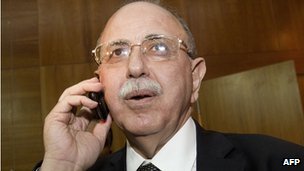 Libya’s interim authorities have named Tripoli academic Abdurrahim al-Keib as the new prime minister.
The National Transitional Council (NTC) made the announcement days after declaring the country “liberated” following the death of Colonel Gaddafi.
It also coincides with the official end of the Nato air campaign that helped overthrow the long-time leader.
The NTC wants a national congress to be elected within eight months, and multi-party elections in Libya in 2013.
Mr Keib, an academic specialising in electrical engineering and based in Tripoli, beat eight other candidates to receive 26 of the 51 votes from members of the NTC.
The BBC’s Katya Adler in Tripoli says he is seen as a consensus candidate who could smooth over rivalries within the NTC.
Mr Keib is expected to appoint a cabinet in the coming days. The new interim government will run Libya until elections are held.
He replaces Mahmoud Jibril, who said he would stand down once Libya was declared officially “liberated” – which happened on 23 October, after the death of Col Gaddafi and the fall of his hometown of Sirte.
Spokesman Jalal el-Gallal said the NTC wanted to form an interim government after the fall of Col Gaddafi because its initial members started out as an impromptu group, the Associated Press news agency reports.
“This vote proves that Libyans are able to build their future,” NTC chairman Mustafa Abdel Jalil was quoted as saying after he voted.
A National Transitional Council was formed in February to act as “the political face of the revolution”.
In March, it declared itself to be the “sole representative of all Libya” and chose Mr Jalil as its chairman.
France was the first country to recognise the council as Libya’s legitimate government.
By the time rebel forces entered Tripoli on 21 August, 35 countries had recognised the NTC government. More than 100 nations now do so.
• Abdurrahim al-Keib’s career
- Graduated from the University of Tripoli
- 1975: went to the US to continue his studies.
- 1985: became professor at the University of Alabama.
- Has also worked at the American University in Sharjah and the Petroleum Institute in Abu Dhabi.
Mission ends
The announcement of the new prime minister came just a few hours before Nato’s mission in Libya was formally due to end, at one minute to midnight Libyan time (21:59 GMT) on Monday.
Nato forces, acting under a UN Security Council mandate to protect civilians, began operations on 19 March as Gaddafi forces moved towards the eastern city of Benghazi to crush the uprising.
Earlier, Nato chief Anders Fogh Rasmussen paid a visit to Tripoli and said the organisation was proud to have played its part during the uprising.
“At midnight tonight, a successful chapter in Nato’s history is coming to an end,” he said at a news conference. “But you have also started writing a new chapter in Libya’s history.”
He said Nato could continue to help with “defence and security reform”, but that it was time for the United Nations to take the lead in international assistance for Libya.