
Sue Reid – Daily Mail Oct 24, 2019
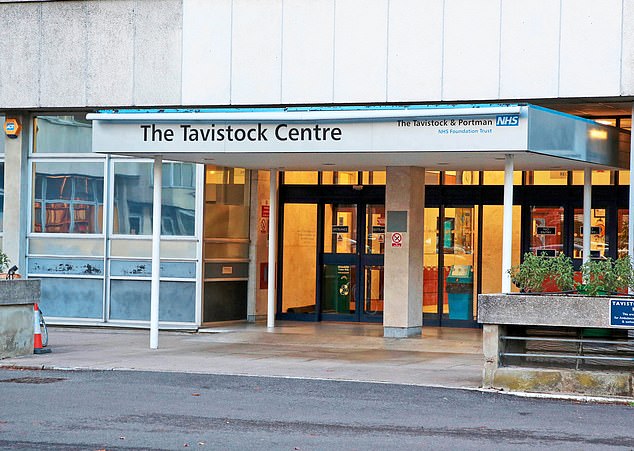
Since 2011, specialists at The Tavistock Gender Identity Development Service in London have seen more than 1,000 under-18s. Is it a coincidence that The Tavistock Centre was actually developed alongside its twin the Tavistock Institute, which is involved in mind control and social engineering? Click to enlarge
This is a case snagged in one of the thorniest controversies of our time.
A mother of a teenager with autism, born ‘Katie’ but who now prefers to be called ‘Jon’, has joined forces with a former nurse to take legal action against the NHS children’s gender clinic, the Tavistock, over its use of ‘experimental’ puberty-blocking treatments for youngsters.
The mother, who is known only as Mrs A to protect her child’s identity, and the nurse, Susan Evans — who herself worked at the Tavistock — believe the clinic is unlawfully administering hormone blockers which halt puberty in gender-confused children but whose long-term physical and psychological effects are unknown.
The pair are asking the clinic to stop treating children with these drugs unless a court decides in each case that it is in their best interests.
The two women have accused the Tavistock and Portman NHS trust, which runs the gender identity development service (Gids) in North London, of misleading families over the treatments, arguing that children and their parents are not adequately informed of the risks.
If their proposed action is unsuccessful, they are demanding a judicial review (where a judge examines the actions of a public body) into ‘unlawful’ hormone-blocking treatments at the clinic.
The Mother’s story
My teenage daughter wants to be a boy, for us to call her Jon, and to wear male clothes. She hopes to take powerful drugs to stop the growth of her breasts, already flattened with a cloth binder worn night and day which she bought online.
In her quest to stop being female, she is to go to the Tavistock clinic, where thousands of children are referred for hormones which, I suspect, harm their fertility, future sex lives and developing brains. No one really knows the truth about these drugs, even in the medical world.
My love for my dear daughter is unconditional. But our family is in turmoil, torn apart over what to do next. Her nine-year-old cousin is so traumatised by my child’s distressed behaviour that she has asked if she, too, has to become a boy when she reaches her teens.
I have no problem with girls wanting to climb trees, fix cars, ride motorbikes, have tattoos and become engineers. But when your daughter tells you she wants to be called by another name because their own female one, Katie, is ‘dead’, then it hurts more than anything.
When Katie tried to kill herself not long ago, a psychologist told me I was part of the problem and could ‘alleviate’ her suffering by going along with what I believe is a lie: that she can change her sex.
She has completely altered from a quirky, opinionated, strong-willed little girl with a heart of gold and a love of animals, into an aggressive, violent and self-centred teenager.
Her friends and teachers at school call her by the name Jon and use the pronoun ‘he’, instead of ‘she’.
But we, her family, have drawn a line in the sand. At home we use her birth name, although she has fought us for doing so.
We felt, as a family, that she could be called whatever name at school. But at home she was Katie. It was what her brothers and sisters knew and understood. I was not going to turn their worlds upside down when I didn’t know if it would last.
The younger three already had to try to understand why the police were at our house in the middle of the night, bringing back their sister after she ran out after an argument with us, her parents, because we wouldn’t call her Jon.
They had to wonder why I hadn’t come home to put them to bed on the day she took an impulsive overdose when we dared to ignore her demands. I was with her, frantically worried, at the hospital while she was sick for hours.
I have been accused of being transphobic, mostly by my daughter. On social media, teenage trolls (who must have heard about me from her posts and those of her friends) say I am an unfit mother for opposing her wishes, for making her unhappy.
At school, I felt I was all alone in still seeing my little girl in front of me; when everyone was calling her ‘he’ and a name I didn’t recognise as hers, because they accepted her new identity.
And our problems still haven’t gone away. Now Katie, with the approval of our GP, is on the waiting list for assessment and treatment at the gender identity development service. Our daughter hopes to get puberty blockers to stop her female development.
Medics she has seen in our local area say she must be allowed to live as a boy. My knowledge of my own child, or thoughts about what might have led to her feeling this way, are ignored. I have deep concerns. I believe that she will be given an experimental treatment that is not adequately regulated and without sufficient safeguards.
There are lots of girls who are seen at the Tavistock and who, like Katie, have autism, or other disabilities, or are simply gay. Are their needs being properly assessed before they are put on puberty blockers? That is what keeps me awake at night.
Katie was first diagnosed with autism at nine, nearly five years ago. She was having behaviour problems at school and had intense one-to-one friendships with girls which, once they broke down, resulted in several parents banning their children from associating with her.
She began to spend more and more time around boys. Her relationships with girls became volatile. They seemed to enjoy putting Katie in situations where they would provoke her, watch her explode, and then say it was her fault.
The boys became her sanctuary. They accepted that she loved football, running around and climbing trees. She was often the first to the top of the tallest tree, leaving the boys on the ground in awe.
But one day she came home from primary school in tears. The boys had mocked another boy because Katie — a girl — had tackled him at football so skilfully.
I believe it was the first time she realised that life might be better if she was a boy.