
Introduction — May 30, 2016
The following article is one of many similar that have appeared in the Western corporate media recently. As if on cue they all echo a similar refrain: Russia and President Putin pose a threat to the West. Our comments follow.
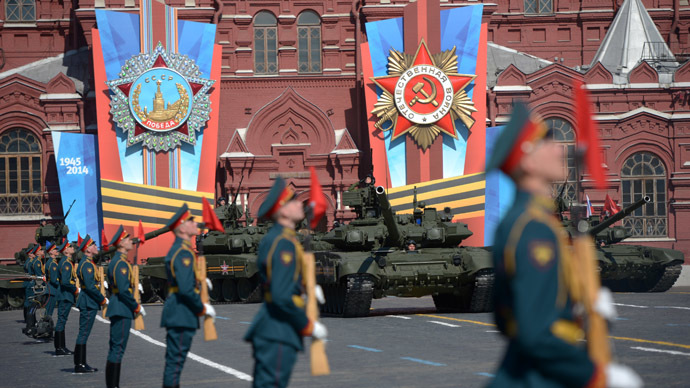
T90s on Red Square during Victory Day 2014.
How serious is Russia’s military threat?
The Week Staff — The Week May 29, 2016
What is Russia up to?
Since annexing the Ukrainian peninsula of Crimea, Russia has been throwing its weight around in Eastern Europe. Russian military planes and ships have been aggressively buzzing U.S. and NATO aircraft and vessels and intruding into European waters and airspace. Russian warplanes recently flew simulated attack passes at an American destroyer in the Baltic Sea, and in April, a Russian warplane did a dangerous barrel roll over an American fighter jet, passing within just 25 feet. In May, British fighter jets intercepted three Russian military transport aircraft — which could carry troops or heavy equipment — approaching NATO member Estonia and refusing to answer hails. British Defense Secretary Michael Fallon described the incident as an “act of Russian aggression.” These provocative actions have occurred at the same time as Russian President Vladimir Putin has been modernizing and upgrading his military forces.
Why the upgrade?
Putin inherited a lumbering and antiquated military from the Soviet Union, along with status as a second-rate power. He wants Russia to once again become a credible counterweight to the U.S. and NATO, and protect its dominion over its traditional sphere of influence. To that end, he has spent billions on a new generation of nuclear missiles as well as new tanks and fighter jets. The Russian military plans to vastly increase its manpower too, announcing 40 new brigades by 2020, on top of the 70 brigades it already has. Whether it can deliver on that plan, though, is debatable, since the oil price slump has hit Russia hard, depriving Putin of needed revenue. But Russia has nonetheless been moving troops and weapons closer to the borders of its neighbors and NATO members. Its Black Sea Fleet, headquartered in the Crimean port of Sebastopol, recently added a dozen warships and has been sending them out on patrols near the Bulgarian, Romanian, and Turkish coasts. “The Black Sea has almost become a Russian lake,” said Turkish President Recep Tayyip Erdogan.
Could Russia rival the U.S.?
There’s no chance of that. Even the top Pentagon brass — who are using Putin’s buildup to argue for greater funding — don’t believe American military supremacy is in jeopardy. The U.S. still spends nearly seven times more on defense (about $600 billion) than Russia ($84 billion), and has 19 aircraft carriers to Russia’s one. And NATO has four times Russia’s military power. Under treaties signed by recent presidents, including George W. Bush and Barack Obama, the two sides have approximate nuclear parity, but the U.S. has hundreds of nondeployed warheads in storage, and Russia does not. Because of these imbalances, says military analyst Daniel Gouré, Russia is relying on intimidation and unpredictable behavior, in the hope that NATO will “accept a small defeat rather than risk a big war” — the very tactic it has used in Crimea and Ukraine. To ratchet up Western fear, Russia has even suggested it would use nuclear weapons in local conflicts.